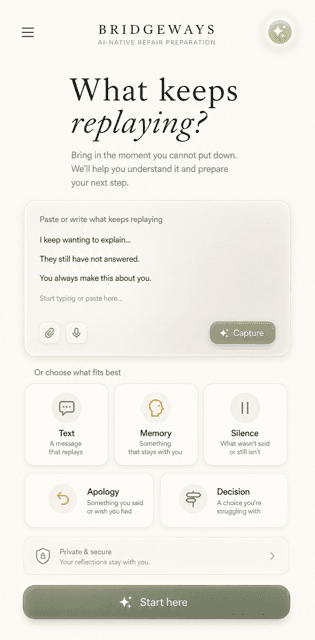
Bring in the moment
you cannot put down.
Start with the text, memory, silence, accusation, apology, or decision that keeps looping in your head.
The message keeps replaying. You do not know whether to reach out, wait, set a boundary, or stop trying. Bridgeways gives you a private place to talk through the pain and practice the hard moments before you decide what comes next.
The relationship may be silent. Your mind may not be. You do not have to wait for an answer before you begin sorting through what happened.
Bring the grief, anger, unanswered question, or message you keep rewriting. Bridgeways helps you work through what happened and practice the hard moment before you choose whether to reach out, wait, set a boundary, or leave it unsent.
Start with the text, memory, silence, accusation, apology, or decision that keeps looping in your head.
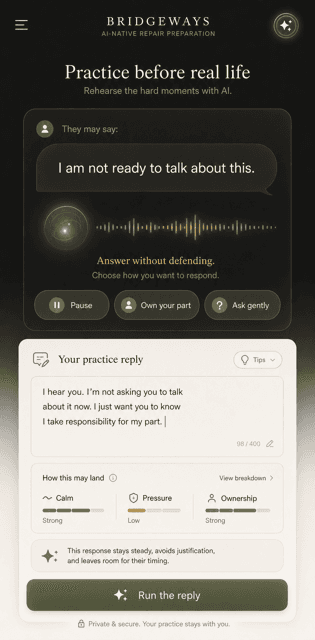
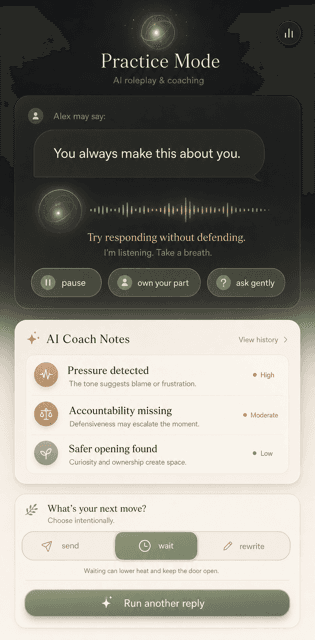
Practice guarded replies, anger, silence, blame, or a small opening without involving the other person.
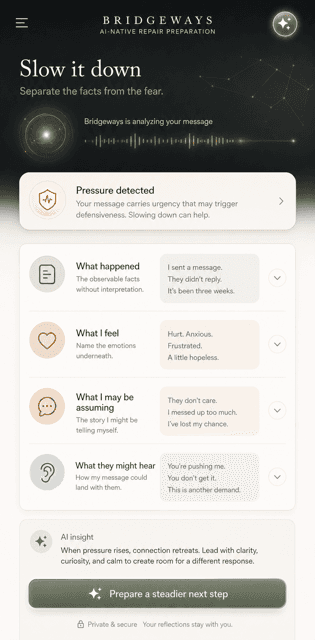
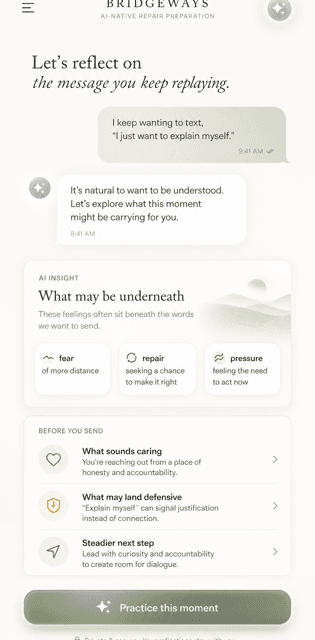
The guide separates what happened, what you feel, what you may be assuming, and what the other person might hear.
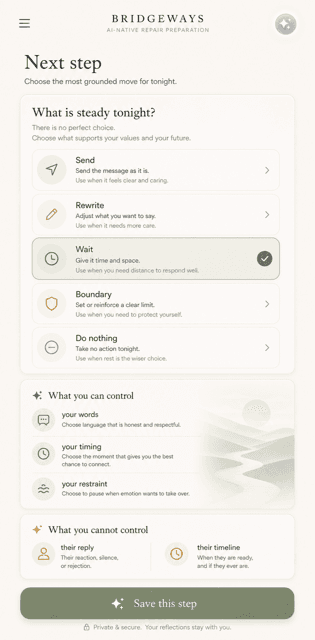
Choose whether to send, rewrite, wait, set a boundary, or do nothing tonight. The choice stays yours, even when the outcome does not.

The words can feel clear in your head and land differently in their body. Bridgeways helps you notice the difference before the message leaves your hands.
Sometimes the message says “I care,” but the fear underneath says “please fix this now.” Bridgeways helps you separate the two.


Bridgeways helps you practice hearing what they may believe, without asking you to call it the whole truth.

Whether they say nothing, push back, or leave a small door open, Bridgeways helps you prepare your next step before emotion chooses it for you.
Keep the draft, the reflection, the warning signs, and the decision you made when you were steady.
Your data remains on your device. We never sell it, never share it, and protect it with industry-standard security. Just anonymous analytics to make the app better.
The words are familiar: wanting the door to open, fearing the next message could make it worse, and needing somewhere private to work through what still hurts.
“I had the text written. It was long. Too long. I kept reading it and thinking, if I just explain it the right way, maybe she'll understand. I did not send it. That was probably the first good decision I made that week.”
What parents are carrying“My son said he never felt emotionally safe with me. I hated that sentence. I still kind of do. But I needed somewhere to look at it without immediately arguing with it.”
What parents are carrying“I miss my grandbabies. That is the part that makes me want to do something stupid. I was going to send a message through someone else, and I'm glad I stopped myself.”
What parents are carrying“I kept thinking, she is still my daughter. How do I act like she is not? I still do not know the answer, but I am not writing from that panicked place tonight.”
What parents are carrying“It did not fix the silence. I want to be honest about that. But it helped me see the difference between saying I love you and trying to force a reply. I needed that difference spelled out for me.”
What parents are carrying“I had the text written. It was long. Too long. I kept reading it and thinking, if I just explain it the right way, maybe she'll understand. I did not send it. That was probably the first good decision I made that week.”
What parents are carrying“My son said he never felt emotionally safe with me. I hated that sentence. I still kind of do. But I needed somewhere to look at it without immediately arguing with it.”
What parents are carrying“I miss my grandbabies. That is the part that makes me want to do something stupid. I was going to send a message through someone else, and I'm glad I stopped myself.”
What parents are carrying“I kept thinking, she is still my daughter. How do I act like she is not? I still do not know the answer, but I am not writing from that panicked place tonight.”
What parents are carrying“It did not fix the silence. I want to be honest about that. But it helped me see the difference between saying I love you and trying to force a reply. I needed that difference spelled out for me.”
What parents are carrying